

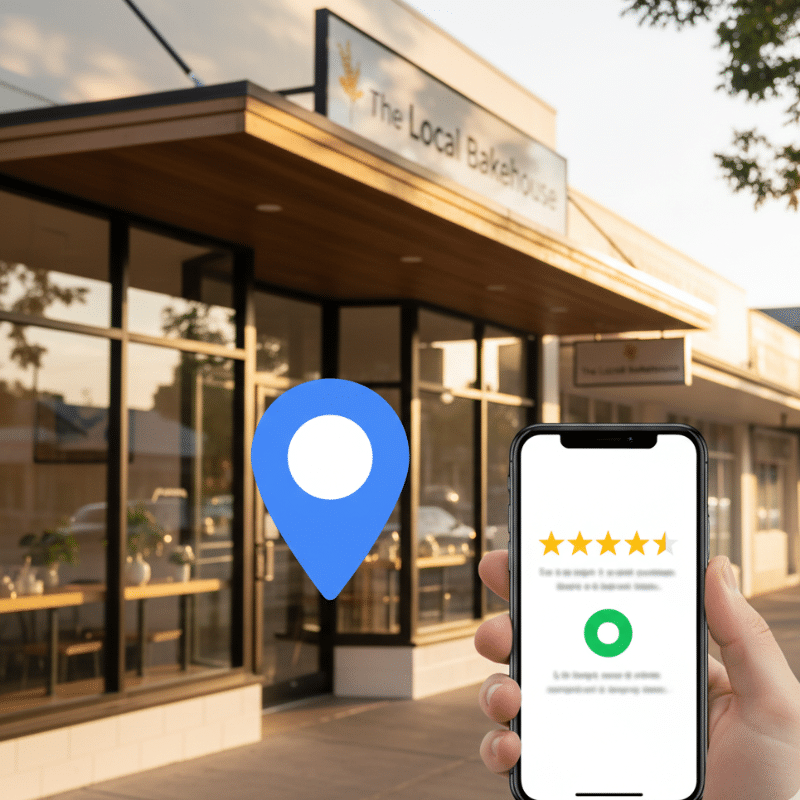
If you’ve ever stared at the Google local results (the map + three listings) and thought, “We’re close… but not #1,”Here’s the good news: being first isn’t the only way to win.
In Australia, a huge chunk of local intent searches end with a phone call, a direction request, a website click, or a booking. And when people are choosing between a few businesses that look broadly similar, they do what humans have always done: they follow social proof.
That’s where reviews come in.
Reviews influence:
- Whether you show up (especially via prominence)
- Whether people click or call (even if you’re not top)
- Whether people trust you enough to convert
This guide breaks down what actually moves the needle for local search performance, how to build a review engine you can run every week, and how to stay on the right side of policy and Australian consumer law while you do it.
Why reviews matter even when you’re not #1
Let’s be honest: users don’t always pick the first listing.
They pick the listing that looks like the safest bet.
When someone searches “accountant near me”, “emergency plumber”, “best dentist”, or “SEO agency Australia”, they’re making a fast decision based on:
- Star rating
- Review volume
- Review recency
- What the reviews say
- Whether the business owner responds professionally
Even competitors in your space highlight that reviews and ratings influence local visibility and customer decision-making.
Google’s local ranking model includes “prominence”, and reviews feed it
Google says local results are primarily based on relevance, distance, and prominence.
You can’t change distance. Relevance is largely about your Google Business Profile and on-site signals. But prominence? That’s where reviews (and reputation signals generally) can give you an edge over businesses that might technically rank above you.
Many industry explainers summarise prominence as being influenced by things like reputation, links, and positive customer reviews.
Reviews help you “win the click” in the map pack
In the local pack, the three listings often look similar at a glance. Reviews create separation in seconds.
If Listing A is #1 with 4.1 stars from 23 reviews, and Listing B is #2 with 4.8 stars from 312 reviews, plenty of users will choose B. That’s not theory—it’s everyday buyer behaviour.
So the practical goal isn’t just “rank #1”.
It’s:
- Out-earn attention
- Out-earn trust
- Out-convert the map pack
The review factors that actually influence local performance
Not all review metrics matter equally. If you want the biggest return for effort, focus on the review signals below.
1) Quantity (review count)
A higher review count usually increases perceived credibility. Competitor guides commonly point to review volume as a meaningful component of local visibility and conversion.
What to do:
- Aim for consistent growth, not one big burst
- Benchmark against the top 3–5 map pack competitors in your main service areas
- Spread review requests across the week (more on cadence soon)
2) Recency (fresh reviews)
Fresh reviews are a strong trust signal. A business with 400 reviews that hasn’t received one in 9 months can look stale next to a business with 120 reviews but 10 new ones this month.
Also, recency helps you in two ways:
- Users see your business as active and reliable
- Your profile maintains ongoing engagement
3) Rating (stars), but with nuance
Yes, star rating matters. But the difference between 4.6 and 4.8 is less important than:
- Whether you have enough reviews to be believable
- Whether the last few reviews are positive
- Whether the content of reviews matches what the user wants
A smaller number of highly positive reviews can outperform a larger number of mixed reviews in conversion terms. But over time, consistent quality + consistent volume wins.
4) Sentiment and themes (what customers say)
This is where businesses accidentally leave money on the table.
People don’t just scan stars; they scan for reassurance:
- “On time”
- “Cleaned up after the job”
- “Explained everything”
- “Upfront pricing”
- “Great with kids”
- “Fast response”
- “Solved our problem first visit”
Those themes influence decisions, and they often align with the exact objections prospects have before they call.
Practical tip:
- Identify your top 5 “trust themes”
- Encourage reviewers (ethically) to mention what mattered most to them
5) Owner responses (reply behaviour)
Replying to reviews isn’t just good manners. It shows:
- Accountability
- Professionalism
- That you value customers
- How you handle complaints
Competitor content frequently recommends responding to reviews and handling negatives as part of local SEO health.
How to win calls and clicks without being #1
Here’s the “not #1” playbook.
Optimise for the fastest trust decision
In the map pack, users make snap judgments. Your job is to win that snap judgment.
Make sure your Google Business Profile and review presence reinforce:
- You’re real
- You’re reliable
- You’re the safer choice
Google explicitly encourages improving your Business Profile to improve local ranking and visibility.
Treat reviews like a conversion asset, not a vanity metric
A review strategy should tie directly to:
- Phone calls
- Direction requests
- Website clicks
- Enquiry forms
- Bookings
If you’re a service business, you don’t need “a lot of reviews”.
You need:
- The right volume to compete
- The right recency to look active
- The right themes to remove buyer hesitation
Make it easy for people to choose you
A few quick wins:
- Request reviews from your happiest customers (systematically)
- Respond to every review (yes, even the short ones)
- Use review insights to improve service delivery
- Add review-driven FAQs and proof points on your site
If you want help building the local SEO foundations that support this properly, explore our professional SEO services in Australia.
A simple Australian review engine you can run every week
If you rely on “hoping” for reviews, you’ll get inconsistent results. Instead, build a small system.
Step 1 — Choose your “review moment”
Pick the moment when customers are happiest. Examples:
- Immediately after a successful job completion
- After a result is delivered (e.g., report, campaign, fix)
- When the customer says “thanks” or gives positive feedback
Step 2 — Make the ask feel human (and specific)
A good review request is short, personal, and easy to action.
Use scripts like:
- “If you felt looked after today, would you mind leaving a quick Google review? It really helps other Australians feel confident choosing us.”
- “If you can mention what we helped you with, that helps people understand whether we’re a good fit.”
Step 3 — Add a follow-up (politely)
Most happy customers simply forget.
A gentle follow-up 24–72 hours later can double your review capture, without being pushy.
Step 4 — Build review requests into your workflow
Where to put it:
- In your invoicing or job completion process
- In your CRM automation
- In your SMS/email follow-ups
- As a checklist item for staff
This is one of the most common “missing pieces” we see when businesses try to improve local visibility: they don’t operationalise it.
If you’re mapping this into a broader growth plan, you can learn more about SEO services that support local acquisition.
Step 5 — Aim for consistent cadence, not bursts
Avoid the “review spike” pattern:
- 20 reviews in a week
- Then none for 3 months
That can look unnatural, and it wastes the recency advantage.
Instead:
- Set a weekly target (e.g., 3–10 reviews per location depending on industry)
- Spread requests across weekdays
- Track results monthly
How to respond to reviews (templates that don’t sound robotic)
Responding to positive reviews
Keep it simple:
- Thank them
- Reinforce a service theme
- Invite them back
Example structure:
- “Thanks, [Name]!”
- “We’re glad we could help with [service outcome].”
- “If you ever need [related service], we’re here.”
Responding to neutral reviews
Neutral reviews are gold, because a great response can turn a “maybe” into a trust win.
Do:
- Thank them
- Acknowledge feedback
- Offer a solution or improvement
Responding to negative reviews (without making it worse)
Negative reviews happen. What matters is how you handle them.
Do:
- Stay calm
- Respond promptly
- Move the conversation offline
- Be specific about fixing the issue
Don’t:
- Argue publicly
- Share private details
- Accuse the reviewer (even if you suspect it’s unfair)
Competitor advice often highlights “tackling negative reviews” as a real part of local SEO and reputation management.
What to avoid (policy + Australian compliance)
This part is crucial.
Fake or misleading reviews can create legal risk in Australia
The ACCC is clear: it’s against the law for a business to create fake or misleading reviews, or arrange for others to do so.
That includes behaviours like:
- Writing reviews for your own business
- Getting staff, family, or friends to post reviews pretending to be customers
- Paying for reviews that aren’t clearly disclosed
- Removing or hiding negative reviews in misleading ways (where you control a review platform)
For the authoritative guidance, see the ACCC guidance that online reviews must be genuine (AU compliance).
Don’t buy “instant reviews”
If a service promises 50 reviews overnight, that’s a red flag.
Even competitor content warns against manufactured reviews and potential penalties when businesses try to game review systems.
Instead:
- Build a real request process
- Make it easy and ethical
- Focus on quality and consistency
Turning reviews into SEO assets beyond Google Business Profile
Reviews don’t have to live only inside Google’s interface.
Use review themes to improve your website content
If your reviews repeatedly mention:
- “fast response”
- “transparent pricing”
- “great communication”
Then your website should explicitly reflect those themes:
- In service page copy
- In FAQs
- In case studies
- In “why choose us” sections
That alignment improves relevance and conversion.
If your goal is a stronger end-to-end strategy, explore our comprehensive SEO solutions for Australian businesses to connect local visibility with revenue outcomes.
Add AEO-friendly FAQs based on what people ask before they review you
AI-driven search experiences often prioritise concise answers. If you publish strong Q&A sections that match search intent, you improve your chances of:
- “People also ask” visibility
- AI Overview inclusion
- Better on-page conversion
Google’s guidance focuses on improving local presence through accurate information and strong profiles, and FAQs help reinforce relevance and clarity.
AEO Q&A: Quick answers Australians ask about reviews and local SEO
Do Google reviews help local SEO?
Yes. Reviews contribute to your overall online reputation and can support prominence, which Google lists as a key local ranking consideration (alongside relevance and distance).
How many reviews do I need to rank?
There’s no universal number. You need enough reviews to be competitive in your local market and category. Compare your business to the map pack listings you want to beat, then aim for steady growth.
Can I get more calls even if I’m not #1?
Absolutely. High review volume, strong recent ratings, and credible review themes can win the click and the call, even if you’re ranked second or third.
Does responding to reviews matter?
It matters for trust and customer experience, and it’s widely recommended as part of reputation management for local search performance.
Are incentives for reviews allowed?
Be very careful. If incentives lead to misleading reviews or undisclosed arrangements, you can create compliance risk. The ACCC guidance stresses that reviews must not be fake or misleading.
What’s the safest way to get more reviews?
Ask real customers after real experiences, make it easy, and follow up politely. Avoid “bulk review” schemes or anything that isn’t a genuine customer opinion.
A practical 30-day plan to improve review-driven local performance
Here’s a simple month-one rollout.
Week 1 — Setup and benchmarks
• Audit your Google Business Profile for completeness and accuracy (services, categories, hours, photos)
• Record your current rating, review count, and last 10 review dates
• Screenshot the map pack competitors and note their review volume + recency
Week 2 — Build the process
• Write 2–3 review request templates (SMS + email)
• Train staff on when and how to ask
• Add “review request sent?” to your completion/invoice checklist
Week 3 — Start cadence + start replying
• Begin your weekly target (small, consistent)
• Respond to every new review
• Identify your top 5 “themes” from recent reviews
Week 4 — Turn insights into content
• Add an FAQ section to your key service pages based on review themes
• Add a short “Why customers choose us” section with the same themes
• Track: calls, website clicks, direction requests, and lead quality
The bottom line
If you’re stuck outside the #1 position, reviews are one of the most controllable levers you have.
Done properly, they:
- Improve how you’re perceived in the map pack
- Increase clicks and calls even without top rank
- Reinforce prominence and trust signals over time
The businesses that win locally in Australia aren’t always the biggest.
They’re the ones that look most credible at the exact moment a customer is ready to choose.
If you want a review-driven local strategy that ties directly to leads and revenue, start with our professional SEO services in Australia.