

Why Search Is Shifting Towards Answers
Google’s Search Generative Experience, ChatGPT, the voice assistants, the screen in the car. They all do the same thing, which is hand you one answer instead of ten blue links. That is already changing how Australians look up products, services and the fiddly compliance questions. The shift has a name, Answer Engine Optimisation, and it puts the weight on information that is concise and verifiable rather than on ranking for a spread of keywords.
Traditional SEO hasn’t stopped mattering. Crawlability, backlinks and the on-page signals are still the ticket to the game. What AEO does is widen the question. It asks whether the content, the markup and the data you publish can actually be pulled out, trusted and served up as the answer. Get both layers right and you stay visible no matter which way the search box evolves.
Owners weighing up the spend often ask if AEO is just another buzzword. Short version: SEO helps a page rank, AEO helps a specific fact surface. They work together, and a proper review, the kind our Answer Engine Optimisation services cover, now sits on most digital roadmaps that are looking more than a year ahead.
Core Differences Between AEO and SEO
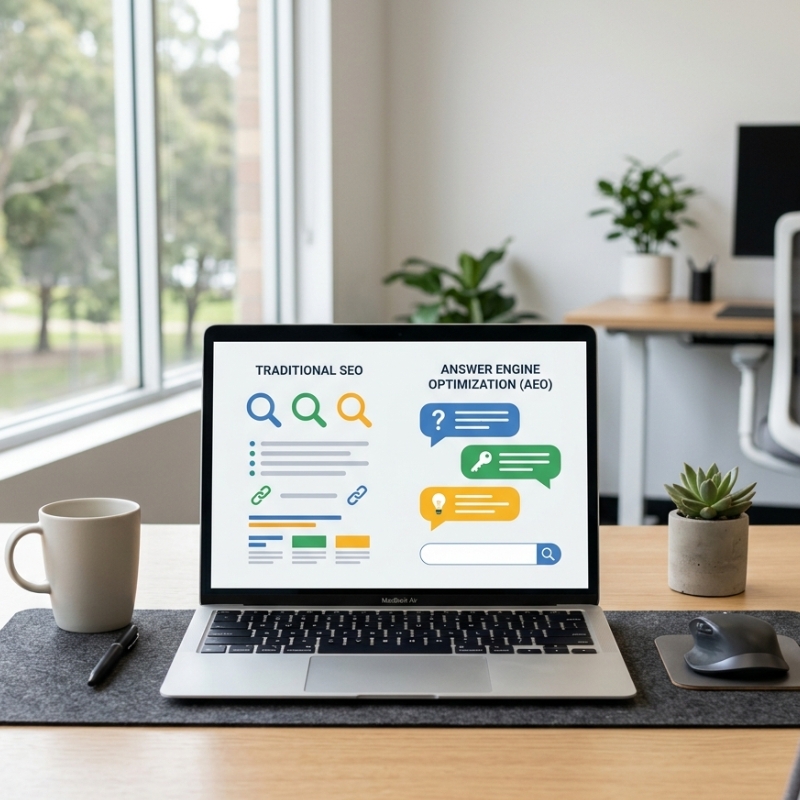
People have been comparing the two for years. The gap got a lot wider once large language models started summarising the web.
| Focus Area | Traditional SEO | Answer Engine Optimisation |
| Primary goal | Improve page rankings for query sets | Deliver precise, verified answers for entity-based questions |
| Key signals | Backlinks, content depth, technical health | Structured data, authoritativeness, conversational clarity |
| Content length | Often long-form for topical depth | Modular snippets plus supporting depth |
| Technical stack | XML sitemaps, robots.txt, speed | Rich schema, entity linking, FAQPage and HowTo markup |
| Success metric | Organic sessions, rankings, CTR | Featured answer visibility, zero-click impressions, assistant citations |
An example makes it concrete. A guide on “electric vehicle tax incentives” written for SEO might run to 2,000 words with the keyword worked through the body. The AEO version keeps that depth, but the thresholds, dates and eligibility rules sit in a marked-up table and link back to the actual legislation. The assistant can then lift the exact figure, say the fuel-efficient Luxury Car Tax threshold of $91,387 for 2025-26 that sets the EV FBT exemption ceiling, and keep the attribution attached to it.
Evaluating Business Impact in 2026
Boards want outcomes they can predict. Three things are pushing AEO up the list:
- Zero-click journeys are climbing. SparkToro’s read of Similarweb clickstream data has around 68 per cent of US Google searches ending without a click in early 2026, up from roughly 60 per cent in 2024. (Gartner’s own forecast, often misquoted here, is narrower: a 25 per cent drop in traditional search volume by 2026 as people move to AI tools.) Either way, the exposure increasingly comes from being quoted, not just linked.
- Compliance expectations are tighter. Platforms are leaning harder on authoritative sources to avoid a misinformation backlash. Content with no provenance, no author, no citations, no government reference, tends to fall out of the assistant’s answer even when it still ranks the old way.
- Local nuance still counts. Assistants get tripped up by state-based building codes, GST quirks and regional slang. A business that publishes precise Australian references earns a trust signal an offshore rival can’t easily fake.
The spend isn’t all-or-nothing. Most firms start by auditing the high-traffic pages, spotting the questions they already answer in passing, and layering on schema like FAQPage and Speakable. Part way in, a lot of teams realise they are already sitting on the good stuff, the policy docs, the spec sheets, the onboarding checklists, all of which can be recut into answer-ready modules.
Around the midpoint of a rollout, people often want to go back to basics. A primer like What Is SEO? sorts out where core optimisation ends and the answer-led work starts. Keeping the two apart is what stops the budget drifting.
How to Future-Proof Your Content
These tactics have held up across B2B, retail and professional-services sites aimed at Australian audiences:
- Map the entity relationships. List the people, organisations, products and regulations your brand keeps referencing. Name them the same way every time, for instance “Corporations Act 2001 (Cth)”, so the semantic engines can join the dots.
- Tighten the passage structure. Break the dense paragraphs into short, self-contained statements. A voice assistant can summarise those without you rewriting the whole page.
- Layer in trustworthy markup. FAQPage, HowTo, Review and Product schema all improve your odds of a rich answer. Pair each one with a cited source, ideally an Australian government or standards body.
- Track the zero-click metrics. Search Console’s “impressions without click” hints at answer visibility. Add assistant logs where you can get them, to catch content that third-party voice devices have picked up.
- Keep the update cadence honest. Assistants drop stale data fast. Put any page carrying dates, thresholds or legislative references on a quarterly review.
Teams that build these habits tend to pick up a few side benefits, faster editorial turnaround and cleaner style consistency among them. Plain English has always been a government requirement, and it happens to suit voice output too. The Commonwealth even formalises the approach through the Australian Government writing style guidelines, the Style Manual co-authored by the Digital Transformation Agency, which is a fair reminder that local tone is worth getting right.
Signs You’re Ready to Add AEO to the Mix
Not everyone needs to pivot this minute. A few signs the timing is right:
- Your SEO rankings are stable but the growth has flattened out.
- Sales keeps fielding the same technical or regulatory questions that need an authoritative reference.
- Support wants to bring the call volume down by feeding clear answers into chatbots and on-device assistants.
- Leadership wants the brand showing up in the newer interfaces, the smart speakers and the in-car systems.
When those line up, AEO tends to pay its way. Fewer escalated queries, a bigger share of assistant citations, and stronger recall among the time-poor people making the decisions.
Quick Answers to Common AEO Questions
Does AEO replace SEO?
No. Traditional optimisation lays the foundation. AEO builds the specialised structures on top of it.
Is schema the only requirement?
Schema is essential, but assistants also weigh up writing clarity, citation quality and topical authority.
How long before results appear?
Early wins like featured snippets can show up within weeks. Broader assistant adoption roughly tracks Google’s indexation cycles, so give it three to six months for a trend line worth reading.
Do small businesses need AEO?
If your customers lean on local voice search, the “near me” and regulatory queries, then even a micro-business gets something out of concise, marked-up answers.
Key Takeaways for Australian Marketers
Search in 2026 runs on direct answers served by AI. Traditional SEO is still essential, but the brands looking ahead are building AEO in now: entity mapping, structured data, plain-language snippets and a disciplined update schedule. That is what keeps you visible whether the prospect clicks a link, hears a spoken summary or reads a chat reply. Run AEO alongside the SEO you already trust and you’ve got a toolkit that holds up for the rest of the decade.